Table of Contents
Are you trying to set up a good payroll schedule? It looks like a complicated task with lots of puzzles. However, once you understand a few basic things, this process becomes super-easy.
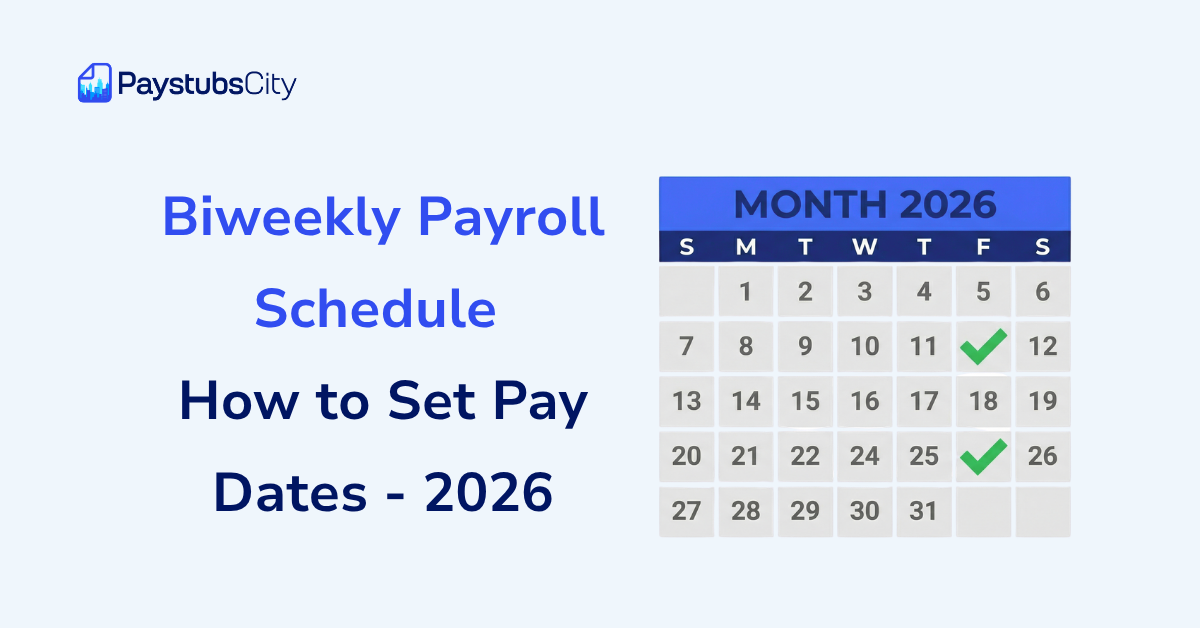
The most common method of paying your team is a biweekly payroll schedule. It means that you pay your workers every two weeks. This occurs on the same day, for example, every other Saturday.
Let’s look at the basic ways to set your dates for 2026. We will also look back at 2025 to see how the dates shift.
What Is Biweekly Payroll?
Biweekly means every two weeks. This means that your team gets 26 paychecks in a year. Now, it may be confusing. Most of the months have 4 weeks, and that totals 24 paychecks. However, two months will have 3 paychecks. This is why people often call them the magic months. Employees get an extra check.
You have to plan these dates in advance. You need to know when the work period ends and when the money goes into the bank. That’s why people utilize a biweekly payroll calendar 2026. It guarantees that you never miss a deadline.
Choosing Your Payday
Companies often pick Friday as payday. It is the end of the work week. People like getting their money before the weekend starts. When you look at your 2026 payroll calendar biweekly, you will see that if you start on January 2nd, your next paydays will be January 16th and January 30th.
If you choose a different day, like Thursday, the pattern stays the same. You just move the dates back by one day. The goal is to keep it consistent. Your employees need to know exactly when to expect their money.
Setting Your Start Date for 2026
To start your biweekly payroll schedule 2026, you first need to look at how 2025 ended. Most businesses just keep the every-other-week cycle going from the year before.
If your last payday in 2025 was December 19th, your first payday in 2026 will likely be January 2nd. If your last payday in 2025 was December 26th, your first one in 2026 will be January 9th.
Let’s look at a sample 2026 schedule:
- ➡️ January: 2, 16, 30 (A three-payday month!)
- ➡️ February: 13, 27
- ➡️ March: 13, 27
- ➡️ April: 10, 24
- ➡️ May: 8, 22
- ➡️ June: 5, 19
- ➡️ July: 3, 17, 31 (Another three-payday month!)
As you can see, planning in advance is vital. Those three payday months might surprise your bank account if you do not plan ahead.
Pay Periods vs. Pay Dates
Many people get confused between the pay period and the pay date.
- ➡️ Pay Period: This is the time your employees actually worked. It means 14 working days for a biweekly schedule.
- ➡️ Pay Date: This is the day the money enters the employee’s account.
Usually, there is a gap of a few days between the end of the pay period and the pay date. This gap gives you time to calculate hours and check for mistakes. It’s the time taken to run your payroll software. If the pay period ends on a Sunday, you might set the pay date for the following Friday.
Your paychecks should always look professional. A paystub generator is a great tool for this. It helps you list all the taxes and hours clearly. Using a paystub generator makes sure your employees understand their pay and saves you a lot of time.
Learning From the 2025 Biweekly Payroll Calendar
It helps to look at the 2025 biweekly payroll calendar to see how the days fall. In 2025, many businesses had their three-payday months in May and October.
Why is this important in 2026? Because the dates shift slightly every year. If you have the biweekly payroll schedule saved, you can see that the days move forward by one day in 2026 (since 2026 is not a leap year).
Checking the calendar guarantees that your new 2026 schedule does not have any overlaps or missed weeks. It is a bridge to your new year of accounting.
Handling Holidays in 2026
Holidays can be tricky for payroll. Banks are closed on federal holidays. If your payday falls on a holiday, you usually have to pay your employees one day early.
Keep an eye on these dates:
- ➡️ January 1 (New Year’s Day): If you pay on Thursdays, you will need to pay on Wednesday, Dec 31st.
- ➡️ July 3 (Observed Independence Day): Since July 4th is a Saturday, the holiday is observed on Friday. If Friday is your payday, move it to Thursday, July 2nd.
- ➡️ December 25 (Christmas): This is a Friday. You should move your payday to Thursday, December 24th.
Prepare your 2026 payroll calendar biweekly, as it shows your team that you care about their time. No one wants their paycheck to be late because of a holiday.
Steps to Build Your Schedule
Ready to build your own? Follow these simple steps:
- ➡️ Pick your first pay date. Look at your final 2025 check and count 14 days forward.
- ➡️ Mark all 26 dates. Use a calendar to circle every other Friday (or whichever day you choose).
- ➡️ Identify Magic Months. Find the two months that have three paydays.
- ➡️ Check for Bank Holidays. Adjust any dates that land on a day the bank is closed.
- ➡️ Set your Cut-off day. Decide when managers must turn in timesheets, so you have time to use your paystub generator and finish the math.
Why Accuracy Matters
If payroll is wrong, employees get stressed. If payroll is late, employees get angry. Using a clear system helps everyone feel safe. A good biweekly schedule is predictable.
You need a good paystub generator and verification process to reduce the chance of making a math mistake. It keeps a record of everything. This is helpful for taxes and for your own peace of mind.
Summary of 2026 Biweekly Dates
To make it easy, here is a quick look at a common Friday biweekly schedule for 2026:
| Month | Payday 1 | Payday 2 | Payday 3 |
| January | Jan 2 | Jan 16 | Jan 30 |
| February | Feb 13 | Feb 27 | – |
| March | Mar 13 | Mar 27 | – |
| April | Apr 10 | Apr 24 | – |
| May | May 8 | May 22 | – |
| June | Jun 5 | Jun 19 | – |
| July | Jul 3 | Jul 17 | Jul 31 |
| August | Aug 14 | Aug 28 | – |
| September | Sep 11 | Sep 25 | – |
| October | Oct 9 | Oct 23 | – |
| November | Nov 6 | Nov 20 | – |
| December | Dec 4 | Dec 18 | – |
In a Nutshell
Don’t consider your payroll a headache. No matter if you are looking at the 2025 biweekly payroll calendar to finish the year or jumping into the biweekly payroll schedule 2026, the steps are the same. Stay consistent, watch the holidays, and use tools to make your life easier.